
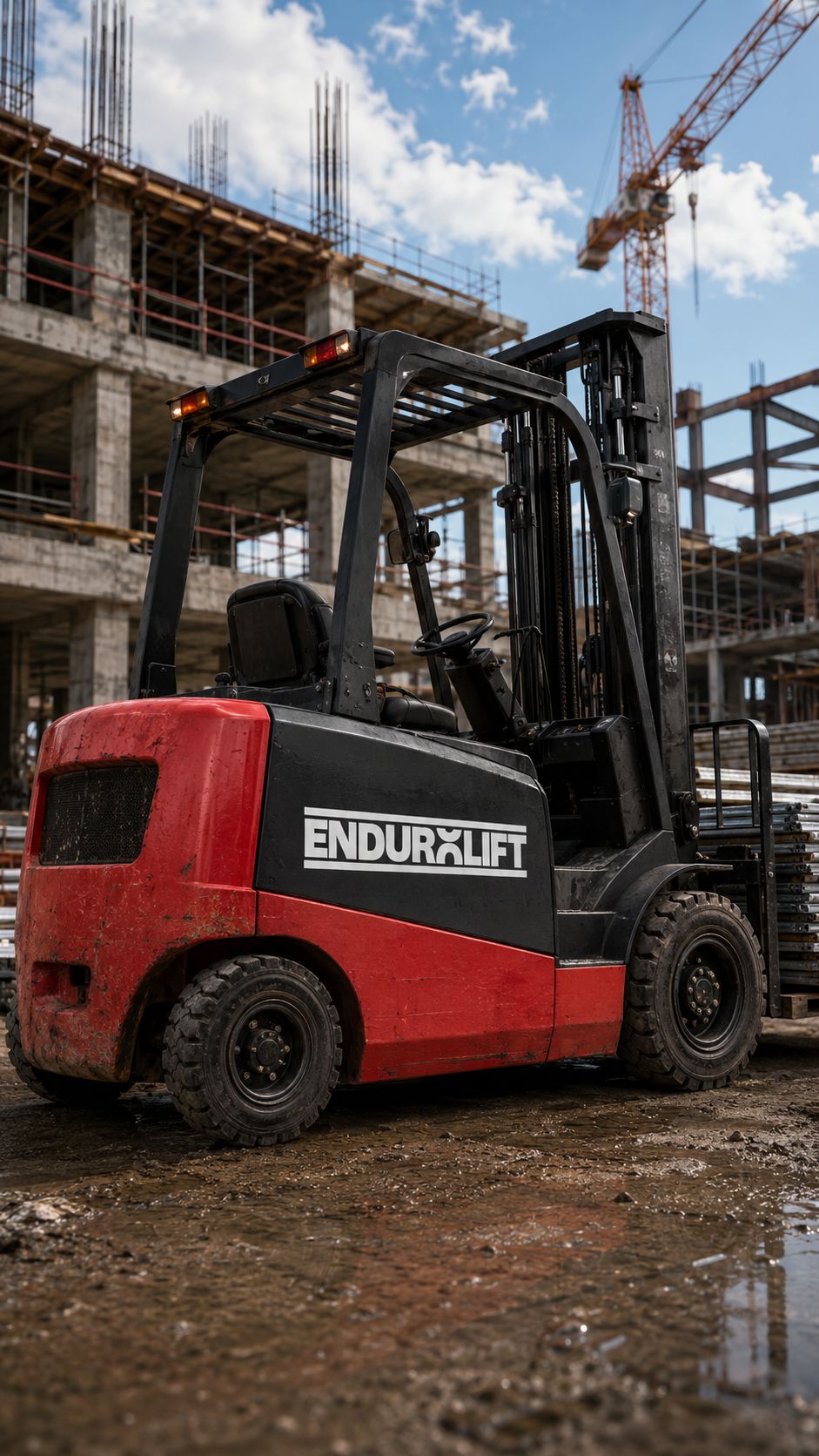
The main difference is the lifting mechanism. A conventional forklift raises loads on a mast and is well suited to repeated material handling on firm, level surfaces. A telehandler uses a telescopic boom that reaches upwards and forwards, helping place loads at height or beyond an obstacle.
Both machines can move pallets, but the best choice depends on where the load starts, where it needs to finish and what lies between those points. For a warehouse replenishing racks throughout the day, a forklift may be the practical fit. For a building site placing materials beyond the edge of an accessible work area, a telehandler's forward reach can make the difference.
Forklift vs telehandler at a glance
This comparison uses a conventional mast forklift as its starting point. The wider forklift family includes specialist reach trucks and rough-terrain models, so the exact design still matters.
| Comparison | Conventional forklift | Telehandler |
|---|---|---|
| Main lifting system | Mast and lifting carriage | Extending telescopic boom |
| Main advantage | Repeated lifting, carrying and stacking | Placement at height and forward reach |
| Common environment | Warehouses, factories and prepared yards | Construction sites, farms and outdoor handling areas |
| Approach to the load | Usually needs close access to the pickup or placement point | Can reach beyond the chassis within its approved working envelope |
| Working-space check | Aisle width, turning radius and rack access | Positioning space, boom clearance and any stabiliser footprint |
| Load-handling equipment | Forks and approved specialist attachments | Forks and other approved attachments for the specific machine |
| Capacity reference | Data plate and residual-capacity information | Model- and attachment-specific load chart |
The table gives you a starting point. To choose a machine, compare its capacity and access at the actual placement point, rather than relying on a general label.
How does a forklift handle a load?
A conventional forklift's forks support the load from below. The carriage travels along the mast to raise or lower it, and the truck moves into position to collect or deposit the goods.
That layout is useful when a business handles similar loads along established routes. A warehouse receiving pallets, storing them and preparing orders for dispatch needs controlled lifting combined with efficient movement between nearby locations. Some forklifts have side shifters, fork positioners or specialist clamps. Reach trucks can extend their load-handling mechanism towards racking. This is why describing every forklift as having 'no forward movement' misses useful differences between designs.
How does a telehandler handle a load?
A telehandler places its attachment at the end of an extending boom. The operator can raise the boom and change its extension to reach a point farther from the machine.
This is useful when close vehicle access is unavailable. Examples include moving a pallet beyond a site obstruction, supplying materials to an elevated landing point or placing agricultural loads where the machine cannot drive directly alongside them. The working envelope has limits. Reach, height, load position and setup must be considered together. A machine's greatest lift height and greatest forward reach are different specifications, and its maximum rated capacity does not apply everywhere within that envelope.
What is the difference between a forklift and a telehandler?
Choosing equipment starts with the job. The most useful differences become clear when you compare the job in six parts.
1. Repeated pallet movements or extended placement?
A forklift is worth considering when your operation revolves around frequent pallet movements, predictable routes and accessible storage. Its value comes from fitting that repetitive workflow. A telehandler is worth considering when materials need to go beyond the point the machine can physically approach. A load does not have to be unusually heavy for forward reach to become the deciding factor. For example, moving pallets between a prepared receiving bay and a nearby storage area is a different task from placing the same pallets across a barrier. The load might be identical; the placement geometry changes the equipment requirement.
2. What ground will the machine work on?
Standard warehouse forklifts work on suitable firm, level surfaces. Many telehandlers are designed with features such as greater ground clearance, rough-terrain tyres and four-wheel drive for outdoor applications.
Those features improve capability in the appropriate environment, but they do not establish that every soft or uneven area is suitable for lifting. Ground support, gradients, edges and underground voids still matter. Assess the working position as well as the route used to reach it.
If your yard is unpaved, describe the surface precisely. Compacted gravel, loose sand and wet ground create different challenges. 'Outdoor use' alone is not enough detail for a useful recommendation.
3. How much space is available?
With a forklift, check the working aisle, turning space, doorway height and pallet dimensions. A truck can fit through a doorway yet still need more room than the aisle provides to turn with a load. With a telehandler, check the approach and setup area, overhead clearance and the space needed for the boom's movement. If a model uses stabilisers for the intended lift, there must also be enough supported space to deploy them as required. Compact telehandlers and specialist forklifts broaden the choices, so avoid assuming size from the machine category alone. Compare the dimensions of the actual options being quoted.
4. What capacity is available where the load must go?
Forklift capacity depends on conditions including load centre, mast, lift height and attachment. Telehandler capacity also changes with the boom's working position and specified setup.
A 4-tonne telehandler is not a promise of 4-tonne capacity at full extension. Equally, a forklift's headline rating should not be assumed to apply to every mast height or attachment. When asking for a recommendation, give the load weight and dimensions, required placement height and forward distance. These describe the lift far more clearly than asking only for a particular tonnage.
5. Which attachment does the work require?
Forks suit supported pallet loads. Other approved attachments handle specific jobs: a clamp may suit a particular industrial load, while a bucket or bale attachment may suit a compatible telehandler's application.
Attachment compatibility includes more than whether it connects. Weight, load centre, hydraulic requirements and the approved capacity information need to match the complete combination. Describe the material you handle before choosing the tool.
6. How will it fit your working hours and budget?
Compare purchase or rental cost alongside transport, energy or fuel, maintenance and the productive work the machine will perform. A lower-priced option offers little value if it cannot reach the placement point or fit the storage layout. For indoor work, an electric forklift can be an attractive option because it produces no exhaust emissions at the point of use. Charging provision and shift requirements still need to suit the operation. For changing outdoor tasks, the telehandler's reach and attachment flexibility may justify a different investment.
Can one machine replace the other?
Sometimes there is overlap. A telehandler can handle suitable pallet loads, and a forklift can perform many loading and stacking tasks. The question is whether that overlap covers your everyday work efficiently. For mixed operations, using both machine types may make sense. A forklift can serve an indoor store while a telehandler handles placement outside. That arrangement should follow the workload and site layout, rather than an assumption that every business needs two machines.
Are telehandlers a type of forklift?
Telehandlers can be described as variable-reach rough-terrain forklifts in some equipment classifications. In everyday buying discussions, 'forklift' often means a conventional mast truck, while 'telehandler' means the telescopic-boom machine. Confirm the exact machine type when discussing training, hire or purchase. The operating competence required should match the equipment and work being undertaken.
Common questions about forklifts and telehandlers
Which machine is better for a warehouse?
For regular pallet handling inside a warehouse, start by comparing suitable forklift types against the racking, aisles and operating hours. Specialist applications may differ, but a telehandler's extra outreach is unlikely to help if the main restriction is a tight storage layout.
Which machine is better for construction work?
A telehandler is often a useful choice when the task involves outdoor access and forward placement. A forklift may suit material handling in prepared storage or loading areas. Choose according to the ground and complete lifting task.
Can a telehandler replace a crane?
It can perform some lifting tasks with the correct approved attachment and configuration. It does not offer every crane capability. Suspended loads require the appropriate chart, equipment and lift planning; the boom's presence alone does not establish suitability.
Does a telehandler always lift higher than a forklift?
No single height comparison applies to every design. Specialist high-lift warehouse trucks and different telehandler classes have different capabilities. Compare the actual load capacity at the height and reach your job requires.
Compare the right machines with EnduroLift
Start with three measurements: your load, the height it must reach and the forward distance to its final position. Add the ground conditions, access dimensions and expected working hours. EnduroLift presents diesel and electric forklifts alongside telehandlers, supported through Forklift Handling's nationwide network.
Explore the EnduroLift range, read our guide on what telehandlers are used for or send an enquiry to compare forklifts and telehandlers for your site.